What Is the Kentucky Bourbon Trail? A Complete Guide
What Is the Kentucky Bourbon Trail? A Complete Guide
The Kentucky Bourbon Trail is an official tourism program created by the Kentucky Distillers' Association in 1999 that organizes member distilleries across the state into a single branded visitor experience. It is not a road, a route, or a ranking. It is a membership program with a map attached, and the trip itself is one you assemble yourself from close to 70 destinations spread across more than two dozen Kentucky counties.
That distinction matters more than any other fact about the trail, because almost every misunderstanding visitors arrive with traces back to it. People expect a marked highway. They expect every famous Kentucky distillery to be on it. They expect a passport to stamp. One of those expectations was true until recently and is not anymore, and the other two were never true at all. This guide covers what the trail actually is, who is on it, who is conspicuously missing, and what a real day of it looks like once you factor in the driving.
The Trail Is Not a Single Road
There is no continuous physical path called the Kentucky Bourbon Trail. No highway carries that name, no single drive connects the stops in order, and you cannot follow it from one end to the other the way you would follow the Blue Ridge Parkway. The trail is a self guided travel experience, which means the Distillers' Association curates the list of participating destinations and you build the actual itinerary.
In practice, the association now leans into this directly. Its current campaign asks visitors to build their own Bourbon Trail rather than complete a fixed circuit, which is an accurate description of how the program has always worked and a more honest one than the word trail suggests.
So the right mental model is a curated list rather than a route. You pick a home base, pick a region, and chain together as many stops as a day realistically allows. Four things people assume about the trail turn out to be wrong, and they are worth clearing up before you plan anything.
How the Trail Started and How Big It Got
The Kentucky Distillers' Association launched the program in 1999 with a small group of distilleries. According to the program's recorded history, it expanded steadily through the 2010s, adding the Bulleit experience at Stitzel Weller in 2014, Old Forester's downtown Louisville distillery in 2018, and Lux Row the same year, alongside a separate Craft Tour launched in 2012 for smaller artisan distilleries. The program was built on top of a much older story, which our guide to where bourbon came from covers in full.
The scale today is a different thing entirely. The association announced in early 2025 that the trail had reached 60 destinations across 27 of Kentucky's 120 counties, and it has kept adding stops since. The official directory now lists closer to 70, a mix of distilleries, visitor centers and a newer category of urban satellite tasting rooms. That number moves often enough that it is worth checking the directory yourself rather than trusting any published figure, including this one. More than 80 percent of trail visitors come from outside Kentucky, and the state reports that bourbon as a whole drives roughly $9 billion in economic impact and supports more than 23,100 jobs.
Visitor numbers have climbed with it. The association now puts annual attendance at more than 2.7 million guests a year, which is worth knowing before you plan a spring or fall weekend expecting quiet rickhouses. For the broader picture of how many distilleries Kentucky actually has, trail member or not, see our guide to how many bourbon distilleries are in Kentucky.
Which Distilleries Are on the Trail, and Which Famous Ones Are Not
Here is the single most useful thing to understand about trail membership: being on the Bourbon Trail is a membership status, not a quality verdict and not a geographic fact. A distillery appears on the official map because it belongs to the Kentucky Distillers' Association and participates in the program. Nothing about the whiskey enters into it.
Which brings us to the two names that confuse more visitors than anything else on this subject. Buffalo Trace and Barton 1792 are not on the Kentucky Bourbon Trail. Both are owned by Sazerac, which withdrew them from the association following a trademark dispute over the Bourbon Trail name around 2009 and 2010. Both distilleries continue to host public tours and promote themselves independently of the association. Buffalo Trace sits in Frankfort, squarely in the middle of trail country, and remains one of the most visited distilleries in the state. It simply will not appear on any official trail map or in any trail material, because those materials belong to a program it is not part of.
If you have read an older guide that lists Buffalo Trace as a trail stop, that guide is out of date. What it is not is a reason to skip the place. The distillery still welcomes visitors, and there is nothing stopping a good itinerary from putting it in the same day as official stops. Our own tours regularly include Buffalo Trace for exactly that reason. The member and non member distinction matters a great deal to the association and essentially not at all to the person holding the glass.
The map below breaks the trail into the six regions the association uses, with approximate drive times and what each region is actually known for. Toggle on the non members to see where those two sit relative to everything else.
What You Actually Do at a Trail Distillery
A standard trail visit is a guided tour followed by a guided tasting, and it usually runs between an hour and ninety minutes door to door.
The tour walks you through production, which means seeing how corn, water and yeast become whiskey inside charred oak barrels. On a working campus that typically includes the mash cookers, the fermenters, the still house, and most memorably a rickhouse, where barrels sit stacked several stories high and the temperature climbs noticeably as you go up. The tasting that follows is usually four to six samples of around half an ounce each, poured in a set order with a guide explaining what to look for. If you have never done a structured tasting, our guide to how bourbon flights and distillery tastings work covers the format in detail.
Beyond the standard tour, many stops have built out experiences that are genuinely distinct from one another. Custom bottle dipping, where you seal your own bottle in wax, has become a signature activity at more than one distillery. Others run whiskey blending sessions where you mix your own batch from component whiskeys, cocktail workshops, barrel thief tastings pulled straight from the wood, and single barrel selection experiences. These usually cost more than the standard tour and usually require booking ahead.
Two practical notes. Reservations are increasingly the norm rather than the exception, particularly at the larger distilleries and on weekends, so check each distillery's current hours and booking requirements before you build a day around it. And tour group sizes are often capped, which matters a great deal if you are traveling with more than a handful of people.
The Passport Program Is Retired
For most of the trail's history, the organizing device was a physical passport booklet. You collected a stamp at each member distillery, and completing the set earned you a reward. It defined how a generation of visitors approached the trip.
It no longer exists. The Kentucky Distillers' Association retired the Bourbon Trail Passport and Field Guide after July 1, 2025, replacing the completionist model with the build your own approach. The association framed the change around slowing down and spending more time at fewer stops rather than racing to collect every stamp.
This is worth stating plainly, because a great deal of trail advice still in circulation tells visitors to pick up a passport and start collecting stamps. That advice is out of date. There is nothing to collect anymore. If a guide tells you otherwise, check when it was written.
What One Day on the Trail Actually Looks Like
The gap between how people imagine a trail day and how one actually runs comes down almost entirely to driving. Distilleries are spread across rural Kentucky, tours run on fixed schedules, and the stops that are worth the trip are frequently the ones furthest out.
Here is a realistic three stop day leaving from Louisville, with the drive time left in rather than edited out.
Three stops is a good day. Four is possible if they are clustered. Five is a march, and people who attempt it generally remember the logistics rather than the whiskey.
How Many Days Do You Need?
There is no single right answer, because it depends on where you stay, how many of you there are, and how much driving you are willing to absorb. The planner below works through all three.
Getting Between Distilleries: The Part Nobody Plans For
Every element of trail planning is solvable except one. You can book tours online, find hotels easily, and map a sensible route in a few minutes. What you cannot solve on a spreadsheet is that a day built around tasting whiskey requires somebody to not taste whiskey.
Run the arithmetic honestly. Three stops at four to six pours each puts twelve to eighteen half ounce samples in front of every person in your group across roughly six hours, with two and a half hours of rural driving threaded between them. Whoever is driving either abstains completely or should not be driving. The association itself maintains a transportation page precisely because this is the structural problem at the center of the experience.
The common workarounds each have a real cost. A designated driver means one person pays full price for a day they experience differently from everyone else. Rideshare coverage is thin to nonexistent once you leave Louisville and Lexington, and getting stranded in Loretto at 4:30pm is a genuine possibility rather than a hypothetical. Splitting into multiple cars means multiple sober drivers and a group that fragments on every leg. And spacing stops far enough apart to sober up between them means doing one or two distilleries a day instead of three.
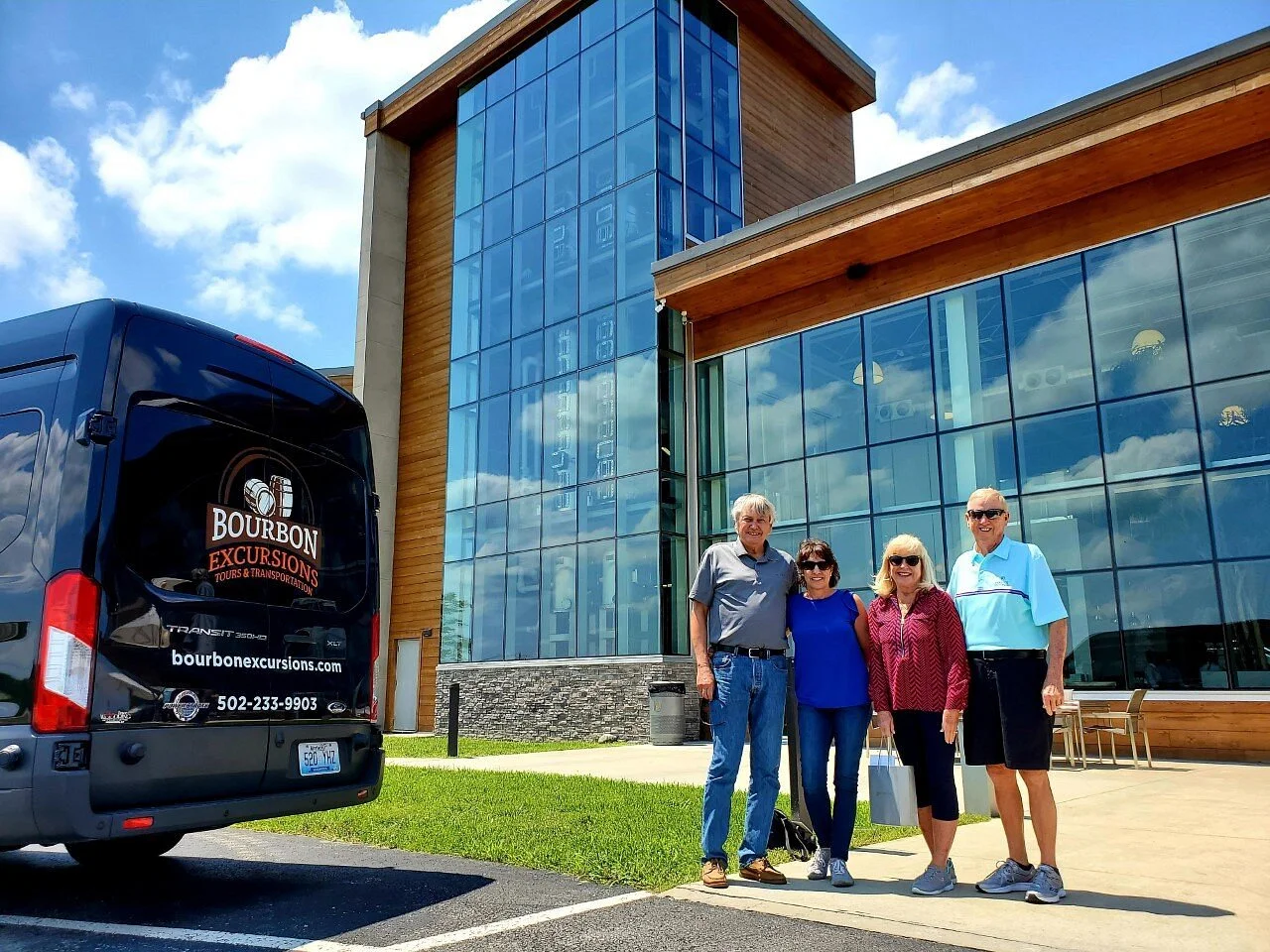
This is the entire reason guided tours exist on the trail, and it is candidly the reason Bourbon Excursions exists at all. We started running private tours out of Louisville because this was the one part of a trail day that visitors could not solve for themselves. Everything else has a workaround. This one just has a cost, and somebody in the group always pays it. Putting everyone in one vehicle with a guide who already knows the routes, the reservation requirements and the people at each stop removes the problem rather than redistributing it, and the whole group gets the same day. However you solve it, solve it before you book anything else, because the answer shapes every other decision about the trip.
Common Questions About the Kentucky Bourbon Trail
Is the Kentucky Bourbon Trail free? The program itself costs nothing to participate in, but individual distilleries charge for tours and tastings. Prices vary widely, and premium experiences cost considerably more than standard tours.
How long does it take to do the whole trail? With close to 70 destinations spread across more than two dozen counties, completing all of them is a project measured in multiple trips over multiple years rather than a single vacation. Most visitors do between three and nine stops on a trip.
Do I need reservations? Increasingly yes, especially on weekends, during peak season, and at the larger distilleries. Walk ins are possible at some stops but should not be the basis of your plan.
Is Buffalo Trace on the Bourbon Trail? No. It left the Kentucky Distillers' Association following a trademark dispute around 2009 and 2010 and is not an official stop. It still runs its own tours and you can absolutely visit it, but you will need to add it to your itinerary yourself.
What is the best time of year to go? Spring and fall bring the best weather and the most comfortable rickhouse visits, which also makes them the most crowded. Summer is hot inside the warehouses in a way people underestimate. Winter is quiet and several distilleries reduce their hours.
Can I buy bottles at the distilleries? Yes, and many offer gift shop exclusives you cannot find elsewhere. Some also offer single barrel selections. Check your home state's rules on shipping and on carrying bottles back. If you are deciding what is worth the suitcase space, our guide to the best bourbon by category is a useful reference.
What should I wear? Closed toe shoes are required at many working distilleries for safety reasons, and you will be walking on gravel, up stairs and through warehouses that are not climate controlled. Dress for a working industrial site rather than a tasting room.
Planning Your Trip to the Trail
The Kentucky Bourbon Trail rewards people who understand what it is before they arrive. It is a program rather than a path, a membership list rather than a ranking, and a trip you build rather than one you follow. Once that clicks, the planning gets much easier, and the only genuinely hard problem left is the driving. Bourbon Excursions runs private guided tours out of Louisville with transportation, admissions, tours and tastings handled, which means every person in your group gets the same day instead of one of you watching from the driver's seat. We make the arrangements, we know the people who make the good stops happen, and we handle the parts of trail logistics that no map solves. If you are planning a bourbon tour in Kentucky, contact us today to start building your own private Bourbon Excursion in the Bluegrass State.

About the Author
Joey Myers

More Posts from the Bourbon Blog