
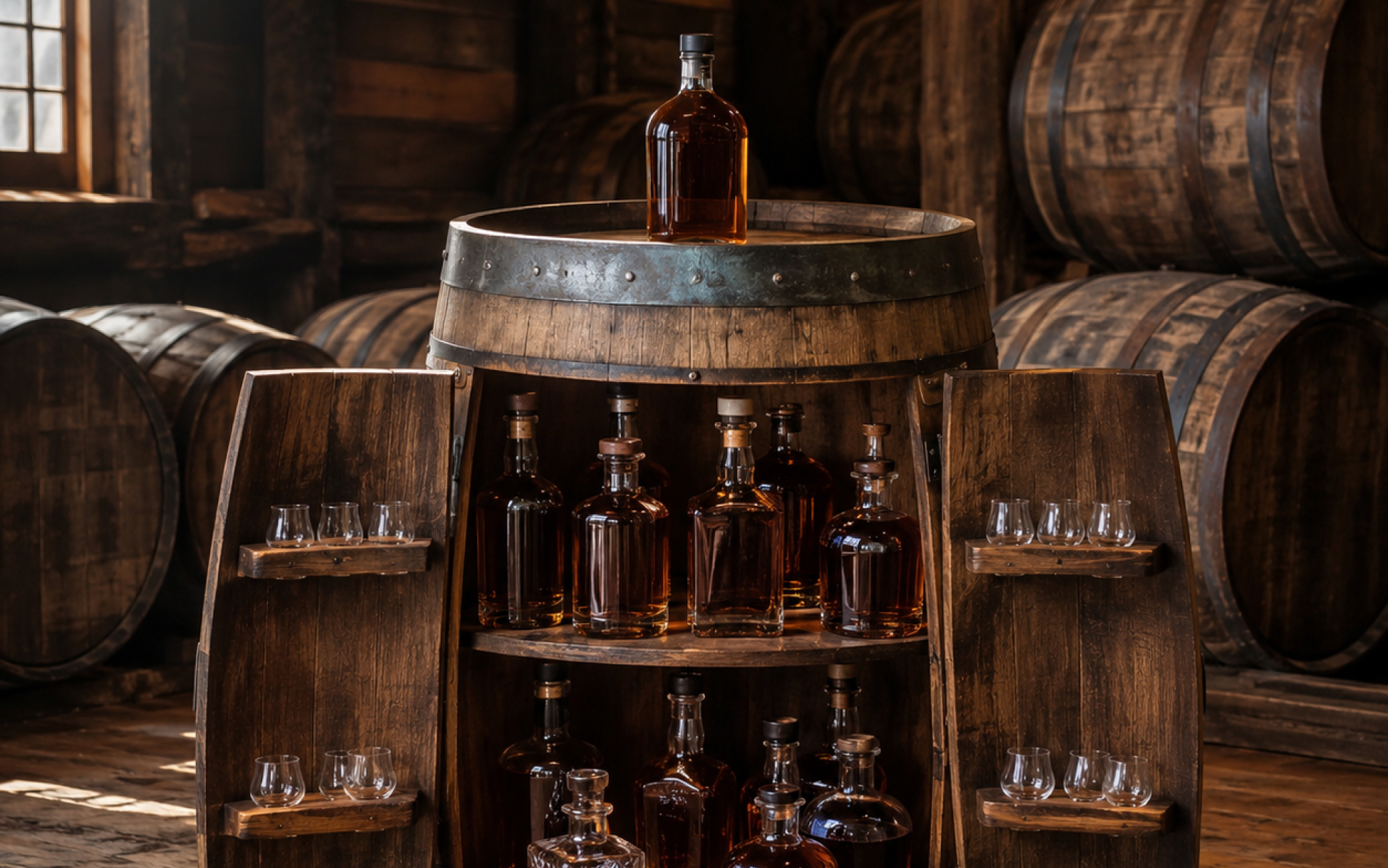
How to Store Bourbon the Right Way
Storing bourbon correctly comes down to five variables: light, temperature, orientation, seal integrity, and container choice. Get all five right and an unopened bottle is essentially stable indefinitely. Get any one of them consistently wrong and the spirit in the bottle will quietly deteriorate in ways that are entirely preventable. The good news is that bourbon is far more forgiving than wine. The bad news is that some of the most common storage mistakes, leaving bottles in sunlight, storing them on their sides, or keeping half-empty bottles for too long, cause damage that cannot be reversed once it occurs.
Why Bourbon Storage Matters Differently Than Wine
Bourbon stops aging the moment it leaves the barrel and enters the bottle. Unlike wine, which continues to evolve chemically in the bottle for years or decades, bourbon's flavor is locked in at the moment of bottling. The alcohol content, which must be at least 40% ABV by law, acts as a powerful preservative that prevents the kind of ongoing biological and chemical activity that transforms wine in the cellar.
This means that good bourbon storage is fundamentally a preservation exercise rather than an aging exercise. The goal is not to improve the spirit but to prevent it from degrading. The enemies are ultraviolet light, heat fluctuation, oxygen exposure, and cork contamination. Address all four and a sealed bottle of bourbon will taste the same in thirty years as it does today.
The Most Important Rule: Keep Bourbon Away From Light
Ultraviolet radiation is the single biggest threat to stored bourbon, and it is the variable most commonly ignored by casual collectors. UV light breaks down the aromatic and flavor compounds in bourbon, particularly the vanillin and color molecules extracted from the barrel during aging. The degradation is cumulative and irreversible. A bottle left on a sunny windowsill for a summer will have measurably different flavor compounds than the same bottle stored in a dark cabinet for the same period.
Even indirect light exposure matters. A bottle sitting on a bar cart in a well-lit room is receiving some UV exposure every day. Fluorescent and LED lighting causes far less damage than sunlight, but direct sunlight even through glass is harmful within weeks. The practical solution is simple: store bourbon in closed cabinets, opaque boxes, or a dedicated dark storage space. If display is important to you, use the display for empty bottles and keep your actual drinking collection in the dark.
Temperature: Cool and Consistent Beats Cold
The ideal storage temperature for bourbon is between 55 and 65 degrees Fahrenheit, roughly the same range recommended for wine cellars. That said, temperature consistency matters more than hitting a specific number. A bourbon stored at a stable 72 degrees is better off than one that swings between 55 and 85 degrees repeatedly through the seasons.
The problem with temperature fluctuation is twofold. First, heat accelerates oxidation, which changes the flavor of the spirit over time. Second, repeated expansion and contraction of the liquid as temperatures rise and fall puts mechanical stress on the cork seal, eventually allowing small amounts of air to enter the bottle and oxygen to begin interacting with the spirit. This process is slow but real, and it is why bourbon stored in a garage that gets very hot in summer and cold in winter will eventually show signs of degradation that the same bottle stored in a cool interior closet would not.
A basement, an interior closet, or a dedicated whiskey cabinet with temperature regulation are all excellent options. What to avoid: near the kitchen oven, above a refrigerator (which generates heat), on top of a cabinet near the ceiling where heat accumulates, or in an uninsulated garage or attic.
Store Bourbon Upright, Not on Its Side
This is the most counterintuitive storage rule for anyone who has ever stored wine, but it is non-negotiable for bourbon. Wine is stored on its side to keep the cork moist and prevent it from drying out and allowing air in. Bourbon should never be stored on its side, for the opposite reason.
Wine corks need liquid contact because wine's low ABV (typically 12 to 14%) is not sufficient to damage the cork. Bourbon's much higher alcohol content, typically 40 to 63% ABV, will actually degrade a natural cork over time when the cork is in constant contact with the liquid. The alcohol breaks down the cork material, eventually introducing off-flavors into the spirit and causing the cork to lose its structural integrity.
The correct storage position for bourbon is upright, with the cork pointing up. In this position, only the alcohol vapor inside the bottle contacts the cork, not the liquid itself. This vapor contact is enough to keep the cork from drying out completely, while avoiding the degradation that liquid contact causes. Every bourbon bottle should stand upright from purchase to consumption.
The Opened Bottle Problem: Oxidation Is Real
A sealed, properly stored bottle of bourbon will outlast you. An open bottle is a different matter entirely. The moment a bottle is unsealed, oxygen begins interacting with the spirit. The aromatics that make a fine bourbon complex and interesting are volatile compounds that gradually oxidize and change over time when exposed to air. The rate of this change depends on how much air is in the bottle.
A bottle that is 90% full after opening has very little headspace and will change slowly. A bottle that is 25% full has significant airspace in constant contact with the spirit and will deteriorate noticeably within months. The practical guidelines are: drink opened bottles within one to two years for best results, and transfer very low bottles into smaller containers to reduce the airspace ratio.
Smaller glass bottles with airtight stoppers work well for consolidating nearly-empty bottles. Some collectors use inert gas sprays, which displace the oxygen in a bottle with nitrogen or argon before resealing. These are available at wine stores and work well for extending the life of open bottles, particularly expensive ones.
The Decanter Problem
A bourbon decanter looks impressive on a bar. It is, however, a poor storage vessel for anything you plan to keep for more than a week or two. The reasons are practical and, for older decanters, potentially serious.
Most glass decanters do not have an airtight seal. A stopper that sits loosely in a glass neck allows constant air exchange, which means the bourbon is oxidizing continuously from the moment you fill the decanter. The flavor change in a decanter over a month can be significant, especially for delicate or complex expressions.
Crystal decanters present an additional concern. Traditional crystal glassware contains lead oxide as a primary ingredient, which gives crystal its clarity and weight. The FDA has noted that acidic or alcoholic beverages can leach lead from crystal containers when stored for extended periods. Modern lead-free crystal does not carry this risk, but antique or unverified crystal decanters should not be used for extended bourbon storage.
The original sealed bottle is always the correct long-term storage container. Decanters are for serving, not storing.
What Happens to Incorrectly Stored Bourbon
The degradation from poor storage is rarely dramatic or sudden. It accumulates slowly. A bottle stored in sunlight for six months may still taste recognizably like the bourbon you bought, but with slightly muted vanilla aromatics, a subtly different color, and a shorter, less complex finish. A bottle stored on its side for a year may develop faint off-flavors from cork contact. An open bottle left too long may smell slightly flat or oxidized, like old apple juice, compared to the fresh, vibrant version the same bottle offered when first opened.
None of these outcomes happen overnight, which is why many casual drinkers never notice them. But someone familiar with a particular expression who tastes it again after improper storage will often detect the difference. For expensive or allocated bottles, the loss is real and irreversible.
The Collector's Question: Long-Term Storage
For bottles intended as long-term investments or keepsakes rather than near-term drinking, all five storage rules become more important, not less. UV exposure compounds over years. Cork degradation from sideways storage accelerates over time. Temperature fluctuations affect seals more severely over decades than over months.
Serious collectors add a sixth consideration: humidity. Very dry air can cause natural corks to dry out slightly even on upright bottles, eventually allowing a small amount of air ingress. Storing bourbon in a space with 50 to 70% relative humidity, similar to a proper wine cellar, prevents cork desiccation without any other intervention. A simple humidity monitor confirms whether your storage space is in range.
Ready to Visit the Source?
Every bottle of bourbon you store at home started its life in a Kentucky rick house, where distillers apply far more controlled versions of the same principles you are managing at home. Bourbon Excursions takes small groups to the distilleries where that storage happens at a scale that has to be seen to be understood, with rick houses stacked eight stories high and tens of thousands of barrels aging inside. If you are planning a bourbon tour in Kentucky, contact us today to start building your trip.

About the Author
Joey Myers

More Posts from the Bourbon Blog

