How Much Does a Bourbon Barrel Hold? Size, Yield, and Cost
How Much Does a Bourbon Barrel Hold?
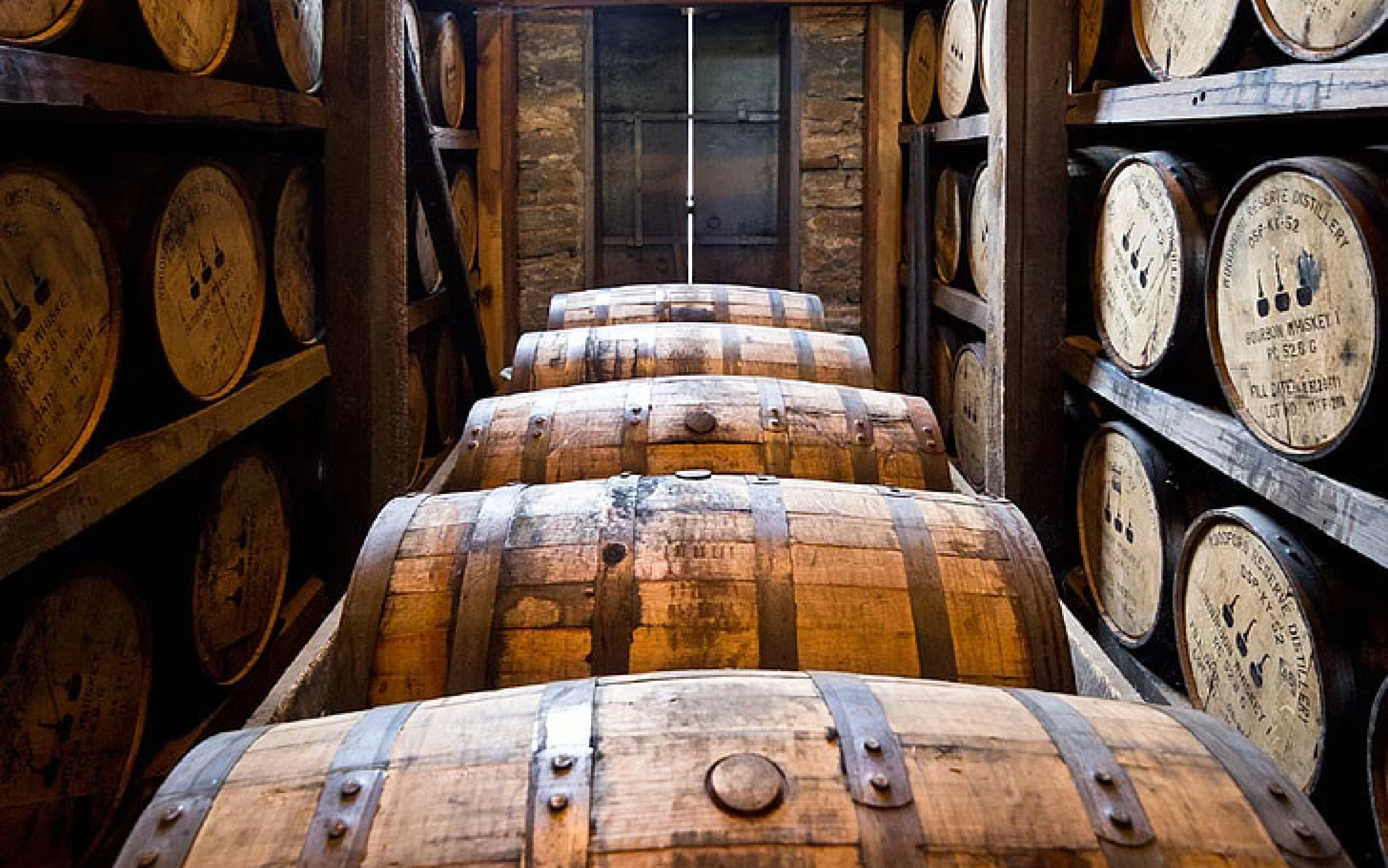
A standard bourbon barrel holds 53 gallons (approximately 200 liters) of spirit. This is the American Standard Barrel (ASB), the near-universal container for Kentucky bourbon aging. It is constructed from American white oak, charred on the interior, and sealed with a bung plug. When full, a 53-gallon barrel weighs roughly 500 pounds. Empty, the barrel itself weighs around 110 pounds. These are the dimensions that define American bourbon production at an industrial scale: as of 2023, more than 11 million barrels of bourbon were aging in Kentucky warehouses at any given time.
Why 53 Gallons?
The 53-gallon size is not legally mandated. Federal regulations require that bourbon age in new charred oak barrels but set no minimum or maximum size. The 53-gallon standard emerged through industry convention across the 20th century and became dominant for practical reasons: it is large enough to produce meaningful volume, small enough to be moved and managed by two workers, and fits efficiently into the standard rick house rack configuration used by Kentucky distilleries.
Smaller barrels are legal and used by many craft distilleries. A smaller barrel has more surface area relative to its volume, which accelerates wood extraction and speeds up aging - the same flavor development that takes 8 years in a 53-gallon barrel may happen in 2 to 3 years in a 5-gallon barrel. Craft producers sometimes use this to their advantage, though the flavor profile produced by a small barrel is notably different from what comes out of the standard 53-gallon vessel over long aging.
How Many Bottles Does a Barrel Produce?
At the moment a 53-gallon barrel is filled, the theoretical maximum yield is approximately 267 standard 750ml bottles. In practice, that number falls significantly by the time the barrel is emptied - for two reasons.
1. The angel's share. Each year in a Kentucky warehouse, roughly 3 to 5% of the barrel's volume evaporates through the wood as vapor. This loss compounds annually. A barrel aged 4 years retains roughly 85 to 87% of its original volume. By 8 years, that drops to around 70 to 75%. By 12 years, to roughly 55 to 62%. By 20 years, fewer than 30% of the original fill may remain. This evaporation is unavoidable and is the primary reason older bourbon commands higher prices.
2. Proofing water. Most bourbon is diluted with water at bottling to reach the desired proof, typically 80 to 100. This dilution actually increases the total liquid volume slightly, adding back some volume in water. At standard 80 proof bottling, a barrel aged 4 to 8 years typically yields between 200 and 240 finished 750ml bottles. Barrel proof expressions, which skip the proofing water addition, yield fewer bottles because no water is added to extend the volume.
The Construction of a Bourbon Barrel
Every bourbon barrel is hand-assembled by a cooper. The staves - the narrow vertical planks that form the barrel's sides - are cut from American white oak (Quercus alba) and shaped with a slight curve to create the characteristic bilge, the wider middle section that allows the barrel to roll and rock. Most barrels use 31 to 33 staves. The heads (the flat circular ends) are also made from white oak. The whole assembly is held together by iron or steel hoops.
Before the barrel is filled, the interior is charred. A cooperage worker briefly sets the inside of the barrel on fire - typically for 35 to 55 seconds depending on the desired char level. The resulting layer of carbon acts as a filter, removing harsh sulfur compounds from the new-make spirit, while the caramelized wood sugars beneath the char contribute vanilla, caramel, and toffee flavors as the bourbon ages.
Char levels range from 1 (light, 15 seconds) to 4 (heavy, 55 seconds, also called alligator char for the cracked texture it creates). Most bourbon distilleries use a No. 3 or No. 4 char. The specific char level is one of the most consequential decisions a distillery makes, directly shaping the flavor profile of every barrel it produces.
Barrel Size Variations
While the 53-gallon American Standard Barrel dominates Kentucky production, other sizes exist and are legally permitted for bourbon aging. Quarter casks (approximately 13 gallons) and half barrels (around 25 gallons) are used by some craft producers specifically to accelerate aging. Hogsheads (63 to 66 gallons) are occasionally used and produce a somewhat different flavor profile due to the altered surface-area-to-volume ratio. The larger the barrel, the slower the wood extraction and evaporation per unit of liquid - and therefore the longer the bourbon typically needs to age to reach the same level of maturity.
One Use Only
Federal law requires that bourbon be aged in new charred oak barrels. A barrel can be used to age bourbon exactly once. After being emptied, used bourbon barrels enter a thriving secondary market. Scottish distilleries purchase them in large quantities for Scotch aging, prizing the residual bourbon flavors they impart. Irish, Japanese, and craft producers around the world do the same. A used bourbon barrel will typically age another spirit for 10 to 20 years in its second life before being retired to furniture, garden decor, or cooperage recycling.
The bourbon industry is, in this sense, the world's largest supplier of used barrels. The single-use requirement - unusual by global spirits standards - means Kentucky's distilleries cycle through an enormous volume of new wood each year, which itself is part of what gives American bourbon its distinctive, wood-forward character compared to most Scotch or Irish whiskey aged in previously used casks.
How Much Does a Barrel of Bourbon Cost?
The answer depends entirely on what you are buying.
An empty, used bourbon barrel - just the wood, no liquid - sells for roughly $50 to $200. These are widely available from distilleries and barrel brokers and are popular for homebrewing, wine aging, furniture making, and garden use.
A new, virgin charred oak barrel from a cooperage costs $200 to $600 for a standard 53-gallon, depending on the cooperage, wood quality, and current market conditions. During periods of high bourbon demand, cooperage lead times have stretched to 18 months or more.
A private barrel selection - where an individual or group works with a distillery to taste and select a specific aging barrel, then has it bottled with a custom label - typically costs $5,000 to $12,000 for a 4 to 8 year bourbon. Many major Kentucky distilleries offer these programs, including Buffalo Trace, Four Roses, Maker's Mark, and others. The process usually involves visiting the distillery, sampling from candidate barrels in the rick house, and selecting a favorite. The Kentucky Distillers' Association has information on which distilleries offer these experiences.
Very old or allocated barrels from prestigious producers can cost $15,000 or significantly more, with prices driven by the reduced yield from the angel's share, the rarity of the brand, and the depth of flavor produced by extended aging.
One important clarification: federal law prohibits direct sales of bourbon from a distillery to a consumer under the U.S. three-tier distribution system. Private barrel purchases must be transacted through a licensed retailer. The distillery selects and holds the barrel, but the actual sale goes through a retail partner.
Seeing a Barrel Program in Person
A Kentucky distillery tour is where the barrel goes from an abstraction to something you can touch, smell, and taste. Most distillery tours include time in the rick house, where guides explain how barrels are racked, why position matters, and what happens to the spirit over years in the wood. Some tours include a thief sample - bourbon drawn directly from a barrel in progress - which is among the most memorable experiences Kentucky bourbon tourism offers.
Ready to See the Barrels for Yourself?
Nothing replaces standing in a rick house surrounded by aging barrels, hearing the math of gallons and bottles brought to life through a glass drawn straight from the wood. Bourbon Excursions takes small groups to Kentucky's best distilleries, including those with active barrel selection programs. If you're planning a bourbon tour in Kentucky, contact us today to start building your trip.

About the Author
Joey Myers

More Posts from the Bourbon Blog