Why Understanding How Bourbon Is Made Matters
Most people who visit a Kentucky distillery have never thought about what actually happens between a grain bin and a bottle. The tour changes that. Suddenly the amber color, the vanilla on the nose, and the warmth in the finish are not abstract tasting notes — they are the direct, traceable result of specific decisions made at six distinct stages of production.
This is the full process, explained plainly.
Stage 1: The Mash Bill — It Starts on Paper
Before any grain is ground or any water is heated, a bourbon begins as a recipe. The mash bill is the precise combination of grains that will be cooked, fermented, distilled, and aged. Under 27 CFR § 5.143, at least 51% of that grain mixture must be corn. Most Kentucky distilleries use considerably more — typically 65 to 75% corn — because the legal minimum is a floor, not a target.
The remaining grains are called flavor grains. They are where each distillery quietly defines its house style. Rye as the secondary grain produces a dry, peppery, spicy character that balances the corn’s sweetness. Wheat as the secondary grain produces a softer, rounder, more approachable result. Malted barley is almost always present in small quantities regardless of style, because its enzymes are essential to converting grain starch into fermentable sugars.
The mash bill is the single most consequential flavor decision a distillery makes. Everything downstream can refine and develop the character that starts here, but it cannot fundamentally change it.
Stage 2: Milling and Mashing — Turning Starch Into Sugar
The grains are ground into coarse flour and cooked with water in large heated vessels. Heat causes the starch granules locked inside the corn to gelatinize and become accessible to enzymatic activity. The malted barley’s enzymes then break those starches down into fermentable sugars in a process called saccharification.
The resulting liquid is the mash — thick, sweet, and grain-forward. Nothing has been fermented yet. Kentucky’s limestone-filtered water plays a meaningful role at this stage: it is naturally iron-free, which matters because iron kills yeast, and it is rich in calcium and magnesium, both of which support healthy fermentation.
Stage 3: Fermentation — Where Alcohol Is Created
Yeast is added to the cooled mash and fermentation begins. Over three to five days, the yeast consumes the fermentable sugars and produces alcohol, carbon dioxide, and hundreds of flavor-active compounds called congeners. These congeners — esters, aldehydes, organic acids, and fusel oils — are the flavor precursors that survive distillation and contribute to the vanilla, caramel, fruit, and spice in the finished bourbon.
Most Kentucky distilleries use the sour mash process: a portion of spent mash from the previous distillation — called the backset — is added to the new fermenter. The backset’s acidity prevents bacterial contamination and ensures consistency from batch to batch. Many distilleries guard their proprietary yeast strains as closely as the mash bill itself. The same grain recipe fermented with a different yeast produces a measurably different bourbon.
After three to five days, the fermented liquid — called distiller’s beer — sits at roughly 8 to 10% ABV and is ready for the still.
Stage 4: Distillation — Concentration and Cuts
The distiller’s beer is pumped into a tall copper column still. Alcohol boils at a lower temperature than water, so when the beer is heated, alcohol vapor rises through the still, condenses, and is collected as a liquid at a much higher concentration. Most bourbon is distilled twice: once through the column still, and once through a doubler or thumper for a second pass.
Federal law caps bourbon distillation at 160 proof (80% ABV). This ceiling is deliberately designed to preserve the grain-derived flavor compounds that higher-proof distillation would strip away. During distillation, the operator makes cuts — separating the heads (early, harsh vapors), the hearts (clean and flavorful), and the tails (heavier, oily fractions). Only the hearts become bourbon.
The result is called white dog or new make — a clear, high-proof spirit that tastes nothing like finished bourbon. It has no color, no vanilla, no caramel. Everything associated with mature bourbon has yet to be created.
Stage 5: Barrel Aging — Where Bourbon Is Truly Made
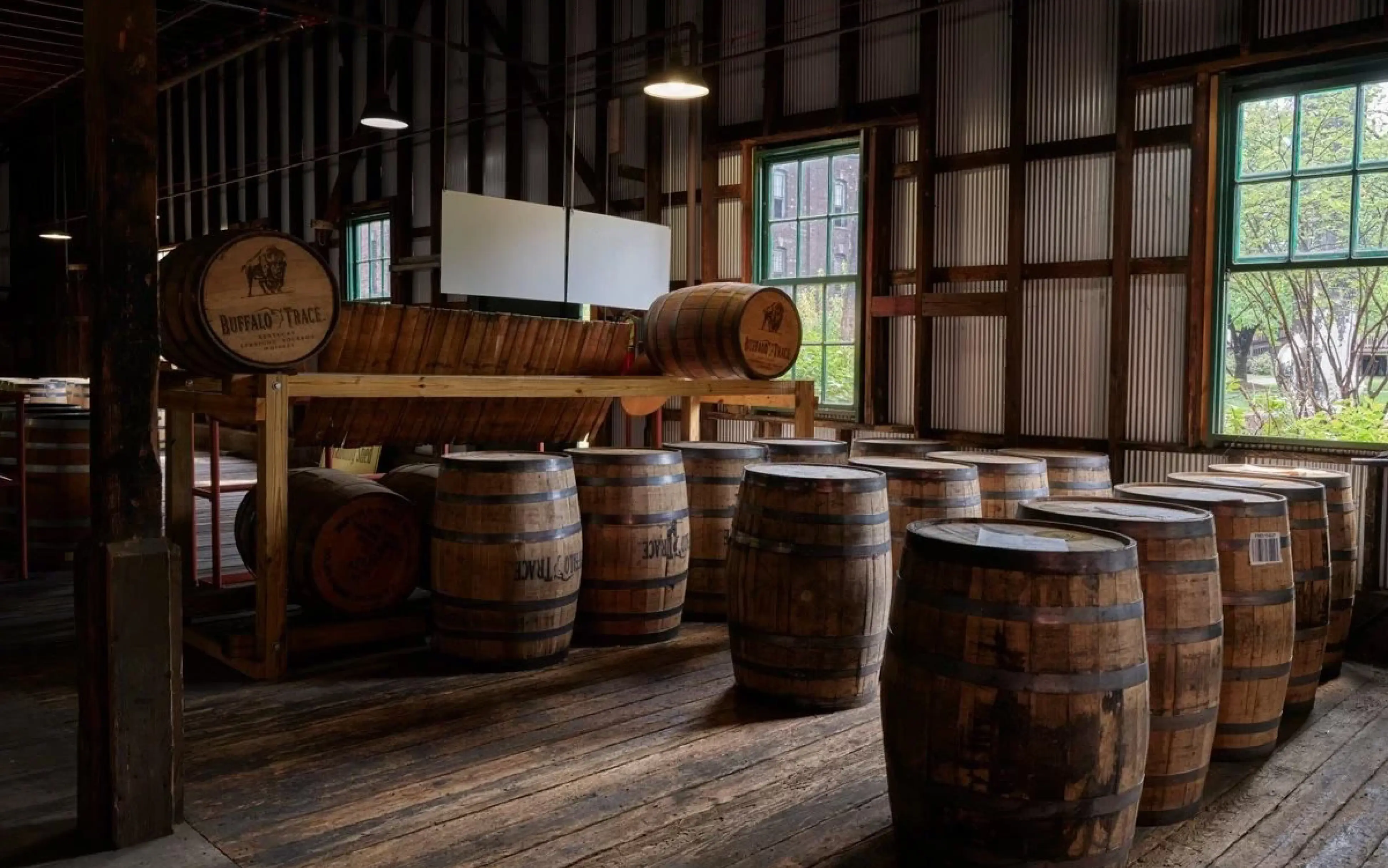
White dog is diluted to no more than 125 proof and sealed inside a brand-new, charred white oak barrel. This barrel requirement is mandated by federal law and applies to every single batch. The barrels are stored in rick houses, where Kentucky’s climate does the real work.
The char level of the barrel — rated 1 through 4 — determines the character of the caramelized wood layer the spirit passes through. Char #3 is the industry standard, producing bold vanilla and caramel. Char #4, called the alligator char because the charred wood cracks into scale-like patterns, produces a bolder, smokier profile. Kentucky’s hot summers push the spirit deep into the wood; cold winters pull it back. This seasonal cycling over four, six, eight or more years builds layered complexity that no artificial process can replicate.
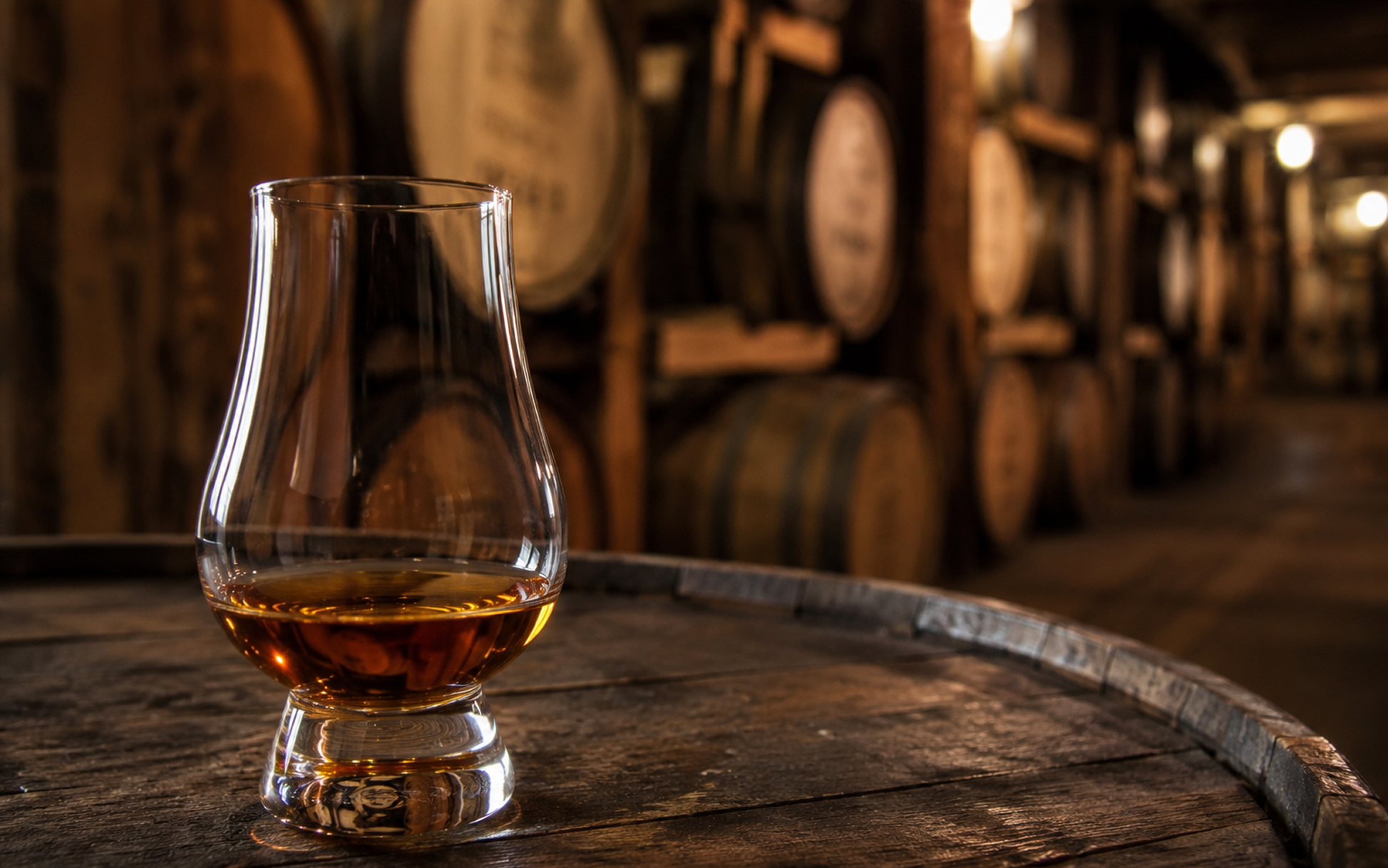
The amber color in your glass came from this step. The vanilla and caramel came from this step. More than half of a finished bourbon’s flavor profile is created during barrel aging — not at the still.
Stage 6: Bottling — The Final Decision
When a barrel reaches its peak, the bourbon is drawn out, evaluated, and typically blended with other barrels to achieve a consistent house profile. Water is the only thing that may be added — to reduce to the desired bottling strength, minimum 80 proof. No caramel coloring, no flavorings, no sweeteners. The color and flavor in the bottle came entirely from the grain and the barrel.
Some expressions are bottled without water addition at all — labeled cask strength or barrel proof, typically running 110 to 140+ proof. Once bourbon leaves the barrel and enters the bottle, it stops aging. The moment the bottle is sealed, the flavor is locked in.
What This Means for a Distillery Visit
Understanding the production process transforms a distillery tour from a pleasant walk into something genuinely illuminating. The rick house stops being a warehouse and becomes a laboratory where seasonal chemistry has been working for years. The still room becomes legible. The barrel the guide opens for you to smell is not a prop — it is bourbon in the middle of its formation.
The best Kentucky tours walk you through this entire process in sequence, ending with a tasting that makes the flavor story explicit. When the guide explains that the caramel came from the char and the spice came from the rye in the mash bill, you understand the choices that were made before any grain was ever cooked. That is the value of understanding how bourbon is made: it gives you a framework for every bottle you pour for the rest of your life.

About the Author
Joey Myers

More Posts from the Bourbon Blog