Bourbon vs. Irish Whiskey: How Are They Different?
The Short Answer
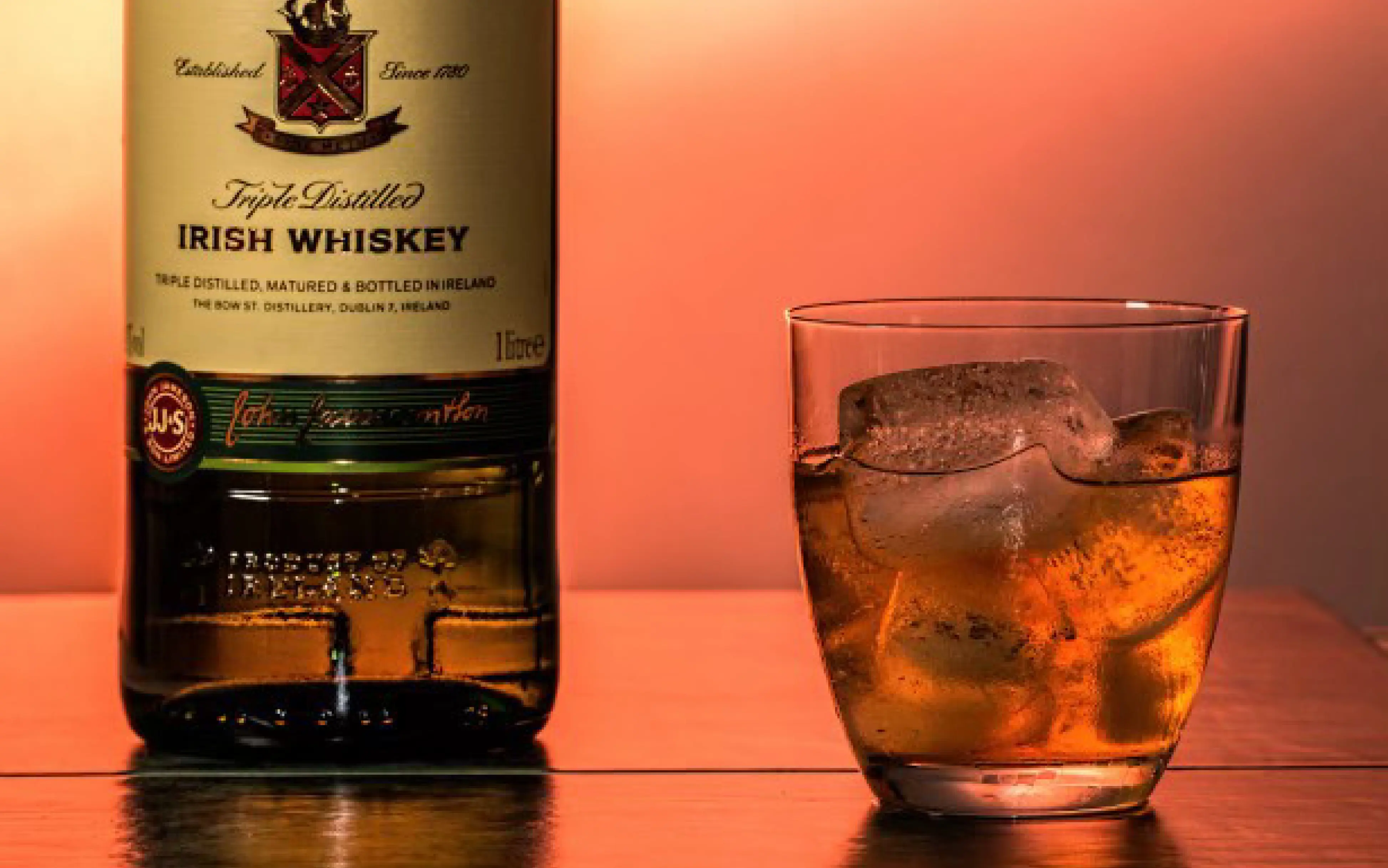
Bourbon and Irish whiskey are both whiskeys, but they diverge at almost every stage of production. Bourbon is an American spirit built on corn, double-distilled, aged in brand-new charred oak, and governed by some of the strictest purity rules in the spirits world. Irish whiskey is made from malted and unmalted barley, triple-distilled in most cases, aged in used oak casks for a minimum of three years in Ireland, and produces a noticeably smoother, lighter character as a result.
The differences are not cosmetic. They trace back to fundamentally different grain choices, different distillation philosophies, and radically different barrel requirements — and each of those choices produces a measurably different spirit in the glass.
What Is Irish Whiskey?
Irish whiskey is a protected geographical indication governed by the Irish Whiskey Technical File, which defines four distinct legal styles: Single Malt, Single Grain, Single Pot Still, and Blended. To carry the Irish whiskey designation, a spirit must be distilled and aged on the island of Ireland — either the Republic of Ireland or Northern Ireland — and must be aged in wooden casks for a minimum of three years.
Irish whiskey is one of the oldest recorded whiskeys in the world. The Annals of Clonmacnoise mention “Aqua Vitae” in Ireland as far back as 1405, predating written Scotch records by nearly a century. The Old Bushmills Distillery in Northern Ireland, which received a license to distill in 1608, is the oldest licensed whiskey distillery on record.
The four Irish whiskey styles are genuinely distinct from each other, and understanding them matters for understanding what “Irish whiskey” actually means:
• Single Malt Irish Whiskey is made from 100% malted barley at a single distillery, distilled in pot stills. It shares the same base grain as Single Malt Scotch but lacks peat smoke in most cases, producing a lighter, fruitier character.
• Single Grain Irish Whiskey is made from a mash that includes grains other than malted barley — typically corn or wheat — distilled in column stills. It tends to be light, approachable, and often forms the base of blended Irish whiskeys.
• Single Pot Still Irish Whiskey is unique to Ireland and has no equivalent anywhere in the whiskey world. It is made from a mixture of malted and unmalted barley, distilled in copper pot stills at a single distillery. The unmalted barley creates a rich, creamy, oily texture and a spicy, full-bodied character that distinguishes this style from all others. Redbreast, Green Spot, and Powers are classic examples.
• Blended Irish Whiskey combines two or more of the above styles from different distilleries. It accounts for the vast majority of Irish whiskey sold globally — Jameson, Bushmills Original, and Tullamore D.E.W. are all blends.
What Is Bourbon?
Bourbon is an American whiskey governed by 27 CFR § 5.143. To legally carry the bourbon label, a spirit must be produced in the United States, made from a grain mash of at least 51% corn, distilled to no more than 160 proof, entered into the barrel at no more than 125 proof, aged in brand-new charred white oak containers, and bottled without any additives except water.
Kentucky produces roughly 95% of the world’s bourbon supply. The state’s limestone-filtered water, dramatic seasonal temperature swings, and over 200 years of accumulated craft make it the undisputed home of the category. In 1964, Congress declared bourbon a “distinctive product of the United States,” giving it the same kind of legally protected geographic status that Irish whiskey holds under EU law.
Difference 1: The Grain
Bourbon must start from at least 51% corn. Corn ferments into a sweeter, fuller spirit than barley or rye, and that inherent grain sweetness forms the flavor foundation of every bourbon before it has touched a barrel.
Irish whiskey uses no minimum corn percentage. Its character comes primarily from barley — both malted and unmalted. Malted barley contributes familiar biscuity, nutty notes. Unmalted barley, used in Single Pot Still Irish whiskey, adds a distinctive richness and creaminess that is entirely its own. The base character is drier and more grain-forward than bourbon.
Difference 2: Distillation
This is the most consequential production difference between the two spirits.
Bourbon is typically double-distilled: once through a continuous column still, then through a doubler or thumper for a second pass. Federal law caps distillation at 160 proof. That ceiling is intentional — distilling beyond it would strip away the grain-derived flavor compounds that make bourbon taste the way it does.
Irish whiskey is typically triple-distilled. While not a legal requirement, triple distillation is the defining practice of most Irish distilleries. The third distillation further removes harsh congeners while preserving delicate fruit and cereal notes, producing a noticeably lighter, smoother spirit than a comparable double-distilled whiskey. Jameson’s triple distillation is integral to its marketing identity, and for good reason: the additional pass genuinely makes a measurable difference to the resulting spirit.
This divergence in distillation count explains more of the flavor difference between bourbon and Irish whiskey than almost any other factor. Bourbon is bolder because it retains more of the grain’s character. Irish whiskey is smoother because triple distillation removes more of what is rough.
Difference 3: The Barrel
Bourbon must be aged in brand-new, charred white oak — every single batch, no exceptions. The fresh wood extracts maximum vanilla and caramel from the char layer, producing the bold wood-derived sweetness that defines bourbon’s profile. Once the bourbon is removed, those barrels are sold — and Irish distilleries are among the most enthusiastic buyers.
Irish whiskey ages in used casks, most commonly ex-bourbon barrels, alongside ex-sherry butts and ex-port pipes. The used wood has already given its most aggressive flavor compounds to the previous spirit, leaving behind a softer, more integrated oak influence. The fruit and malt character of the base Irish whiskey can remain prominent throughout aging rather than being transformed by bold new wood extraction.
The relationship between these two categories is literal and direct: the same barrel that made bourbon goes on to shape Irish whiskey. Bourbon’s new barrel requirement fuels Irish whiskey’s barrel supply.
Difference 4: Aging Requirements
Straight bourbon requires a minimum of two years in new charred oak. Basic bourbon has no minimum. Most premium Kentucky expressions age between four and twelve years, with some aging considerably longer.
All Irish whiskey must age for a minimum of three years in wooden casks on the island of Ireland, regardless of style. Ireland’s mild, consistent Atlantic climate produces a slower, more even extraction than Kentucky’s temperature extremes, contributing further to Irish whiskey’s characteristic softness.
Difference 5: Additives and Purity
Bourbon permits only water at bottling. No caramel coloring, no flavorings, no sweeteners. The color in your glass came from the barrel. This purity standard is absolute and legally enforced.
Irish whiskey, like Scotch, permits the addition of caramel coloring (E150a) under EU regulations to ensure visual consistency. This is a standard, legal practice across much of the whiskey world and does not affect flavor — but it means you cannot always verify that the color in a glass of Irish whiskey came entirely from the cask.
How They Taste: The Practical Difference
Bourbon is warm, bold, and oak-forward. Corn-driven sweetness, new oak vanilla and caramel, and the spice contribution of the secondary grain (rye or wheat) produce a profile that is assertive and immediately recognizable. The flavor hits quickly and with weight.
Irish whiskey, particularly the blended and single grain styles, is lighter, smoother, and more delicate. The triple distillation removes harshness. The used barrels add wood character without overwhelming the spirit. The result is a whiskey that works exceptionally well as an introduction to the category — approachable without being boring, complex without being demanding.
Single Pot Still Irish whiskey is a notable exception to the “light and smooth” generalization. Full-bodied, spicy, and richly textured, expressions like Redbreast 12 and Green Spot can match or exceed bourbon’s intensity while remaining distinctly Irish in character.
Which Is Better for Beginners?
Irish whiskey’s lighter, smoother profile makes it a natural entry point for people new to brown spirits. The approachability is genuine, not a marketing claim — triple distillation and used barrels produce a spirit with fewer rough edges than most bourbons at the same price point.
That said, a well-chosen wheated bourbon — Maker’s Mark, W.L. Weller, or similar — can be equally approachable, and its corn sweetness and vanilla notes often resonate more immediately with new drinkers than Irish whiskey’s drier, more grain-forward character.
The most useful exercise is tasting them side by side: a blended Irish whiskey like Jameson and a wheated Kentucky bourbon like Maker’s Mark. The differences in body, sweetness, and oak influence become immediately clear. No reading about it conveys the distinction as vividly as two glasses.
The Kentucky Connection
There is a physical, tangible connection between bourbon and Irish whiskey that most drinkers are unaware of. When you taste Jameson, Bushmills, or Redbreast, some of the flavor in that glass came from the same oak that once held Kentucky bourbon. The ex-bourbon barrel is the most common cask in Irish whiskey production.
Understanding Irish whiskey, in this sense, deepens your understanding of bourbon. The two categories are not merely comparable — they are materially linked, sharing wood, sharing history, and producing two of the most consumed whiskeys on earth through fundamentally different approaches to the same craft.

About the Author
Joey Myers

More Posts from the Bourbon Blog